Why a Familiar Saying Can Smuggle in an Assumption
See how a familiar saying can hide an assumption, then compare three ways to restate it as a claim you can examine before relying on it.
“If it isn’t broken, don’t fix it” can make a useful point—and quietly settle an argument before anyone checks what “broken” means. A familiar saying can smuggle in an assumption by making one part of a claim sound like common sense. To examine it, separate the advice from the premise it carries, then choose a way to restate that premise so it can be discussed.
This matters in ordinary decisions, not just formal debates. A colleague may cite “many hands make light work” to support adding people to a project. A family member may say “better safe than sorry” to argue for a precaution. The words sound settled; the situation often is not. The task is not to ban sayings, but to notice what they ask you to accept.
What does a saying leave unsaid?
A maxim usually compresses an observation into advice. Its brevity is part of its appeal, but it can hide conditions that would change whether the advice applies. “The customer is always right,” for instance, can imply that a customer’s account should be accepted even when the facts are unclear. It may also be used to mean that a business should take complaints seriously. Those are different claims.
Try separating a saying into three parts:
- The advice: what action the speaker favors.
- The premise: what must be true for that action to make sense.
- The boundary: when the premise might not hold.
Take “you get what you pay for.” The advice might be to avoid choosing the cheapest option. The hidden premise is that price reliably signals quality in the choice at hand. The boundary could be a product where features are comparable, or where a higher price reflects branding rather than a useful difference.
Once the premise is visible, you can respond to the actual issue instead of arguing over whether the saying is wise in general.
Which restatement suits the conversation?
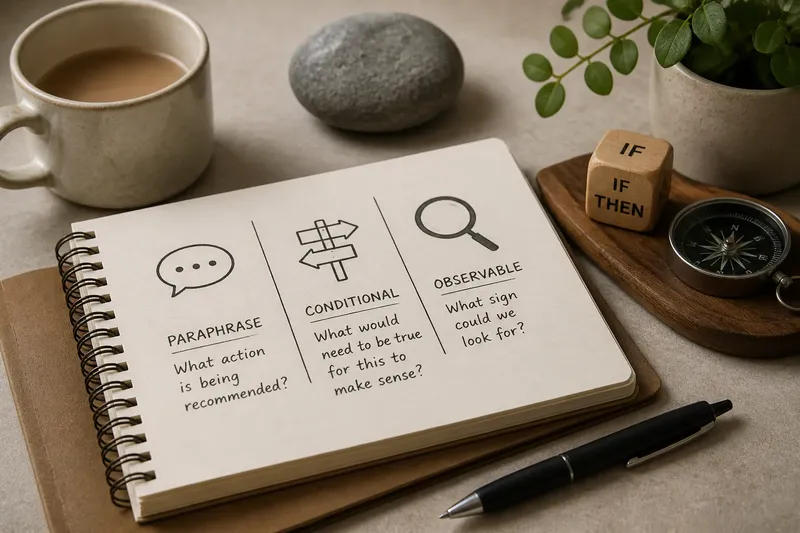
There is no single best way to unpack a maxim. Choose among three approaches according to what the conversation needs: a quick paraphrase, a conditional claim, or an observable test. Each makes a different kind of hidden assumption easier to inspect.
Can you paraphrase the advice plainly?
Replace the saying with the action it recommends, in direct language. “Don’t fix what isn’t broken” might become, “Let’s keep the current process unless we can name a problem it causes.” This works well when the conversation is moving quickly and people need to know what the speaker is proposing.
A paraphrase does not automatically expose every premise. But it removes the saying’s air of authority and gives others something specific to accept, reject, or revise. It suits everyday discussions where the main confusion is what the maxim is being used to recommend.
Can you turn it into an if-then claim?
State the condition that would make the advice reasonable. “If the current process meets the needs of the people using it, we should keep it rather than change it for its own sake.” This makes the premise explicit and leaves room to ask whether the condition is true.
Use this approach when people agree on the broad advice but disagree about whether the situation fits. It also helps prevent a maxim from being treated as a rule without exceptions. The useful conversation becomes: what would count as meeting those needs, and whose needs matter?
Can you name something observable?
Translate the premise into a sign people could look for. Instead of assuming that more helpers will make a task easier, ask whether adding a person would reduce a specific bottleneck without creating extra coordination work. This approach is useful when a decision depends on how a process behaves, rather than on a general principle.
An observable test need not mean running an experiment. It can be a check of the current situation: where work is waiting, what information is missing, or which part of the task is repeatedly causing difficulty. If the relevant sign is absent, the maxim may not support the proposed action.
How do you choose a restatement?
Start with the kind of disagreement in front of you. If people do not understand the proposal, paraphrase it. If they disagree about whether a general rule applies, make it conditional. If the claim turns on what is happening in practice, name an observable sign.
Imagine a team member says, “Many hands make light work,” while proposing that another colleague join a shared task. If the team is unsure what action is being proposed, a paraphrase could be: “You think adding someone will help us finish the task more easily.” If everyone understands that but disagrees about the conditions, make it conditional: “Adding a person could help if enough work is independent and there is room to coordinate.” If the disagreement is about the workflow, identify what is observable: whether work is waiting for capacity or whether people are already losing time to handoffs. Each restatement points to a different conversation, without pretending the saying settles the choice.
A simple selection rule helps: use the least elaborate restatement that reveals the disputed premise. Do not demand evidence for every casual remark. Pause when the saying is doing important argumentative work—when someone uses it to close off alternatives, dismiss a concern, or justify a consequential choice.
What can go wrong when you unpack a maxim?
One mistake is treating every saying as a formal argument that needs a courtroom-style cross-examination. That can make a normal conversation feel hostile. A gentler prompt often works better: “What would need to be true for that advice to fit here?” It invites clarification without implying that the speaker is being careless.
Another mistake is replacing a broad maxim with an equally vague claim. “We should do what’s best” merely swaps one slogan for another. Ask what “best” means in this situation: fewer handoffs, a simpler process, less disruption, or something else? Specific language makes the premise easier to discuss.
Also resist assuming that a hidden premise is automatically false. “Better safe than sorry” may be a sensible reason to take a low-burden precaution, but the burden and the possible harm still matter. Unpacking a saying is not a trick for defeating the person who used it. It is a way to find out whether the advice fits the actual circumstances.
How can you keep the exchange constructive?
Keep your attention on the claim, not on the person’s choice of words. You might say, “I can see the point of that saying. What are we assuming about this situation?” Or try, “Could we say that as a condition rather than a general rule?” These questions preserve the useful intuition while making its limits available for discussion.
When you are the one reaching for a familiar phrase, add the condition yourself. Instead of “you get what you pay for,” say, “A higher price may be worth considering if it buys a feature we actually need.” The added words make your reasoning easier to evaluate and easier for someone else to correct.
For a quick check, listen for a maxim that seems to end the discussion. Restate its advice, identify the premise it depends on, and choose a plain paraphrase, an if-then claim, or an observable sign. That is a practical way to examine a familiar saying without dismissing the useful thought that made it appealing.
A saying can still serve as a memorable reminder. Just let the situation—not the rhythm of the phrase—decide whether its hidden premise belongs in the argument.