Pros-and-Cons List or Criteria Table? Two Ways to Compare Options
A pros-and-cons list or criteria table can make a choice clearer. Learn which format fits your options and how to weigh unlike considerations.
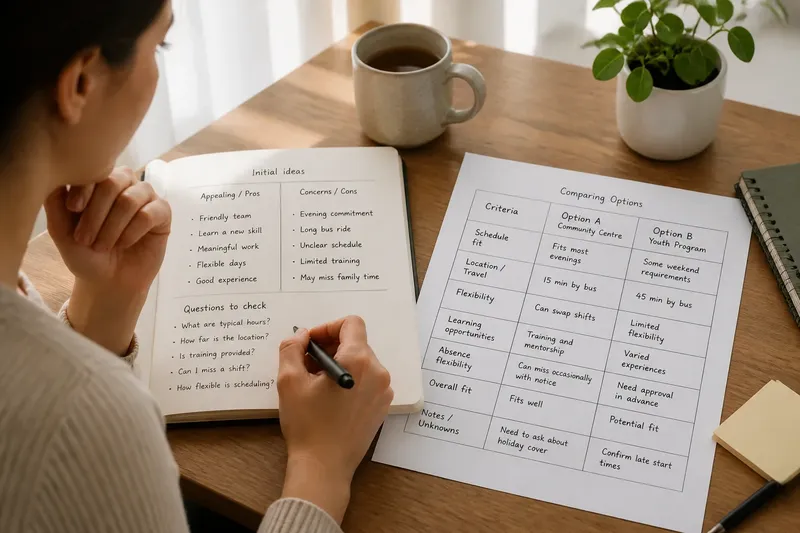
A pros-and-cons list or criteria table can make a difficult choice easier to inspect, but the two formats answer different questions. A list gathers what seems favorable or unfavorable; a table compares each option against the same considerations. The right choice depends on whether you are still discovering what matters or ready to compare specific alternatives.
What does a pros-and-cons list help you see?
A pros-and-cons list is useful when your thoughts are still arriving in fragments. It gives you a quick place to collect appealing features, drawbacks, worries, and possibilities without deciding yet how each one should be ranked.
That freedom can reveal concerns you might otherwise overlook. If you are choosing between two volunteer roles, you may jot down “friendly team,” “evening commitment,” “learn a new skill,” and “long bus ride.” Some points are practical, some personal, and some still need clarification. A list lets them sit together while you get your bearings.
Its weakness is that it can make unlike points look equivalent. One item might be a mild convenience; another might determine whether the option is workable at all. If both occupy one bullet line, the page gives no visual hint about their different importance.
Use the list to gather possibilities, not to count bullets as votes.
When is a criteria table a better fit?
A criteria table is better when you have a defined set of options and want to compare them consistently. Put the options in columns and the factors you care about in rows. Then consider each option against the same factor, such as schedule fit, location, flexibility, or learning opportunities.
The shared rows matter. A list can collect “close to home” for one option and “interesting work” for another, leaving you with no direct comparison. A table prompts you to ask how each option performs on both factors, even if one answer is uncertain or needs checking.
A table is not automatically more objective. The person making it chooses the criteria, decides what counts as a good fit, and interprets the information. A neat grid can make a subjective judgment look settled, so leave room for notes such as “need to ask about weekend shifts” rather than filling every cell with confident-sounding ratings.
Choose a table when the comparison needs to be consistent, not merely because it looks more formal.
How do you keep unlike considerations from counting equally?
First, separate importance from quantity. A long list of minor benefits does not necessarily outweigh one serious drawback. Mark which considerations are essential, which would make an option more appealing, and which are preferences you could trade away.
Next, distinguish a threshold from a bonus. A threshold is a condition an option needs to meet to remain viable; a bonus improves an option but cannot compensate for failing a threshold. For instance, a role might need to fit around caregiving responsibilities. A pleasant commute could be a bonus, but it would not make an impossible schedule workable.
For less decisive factors, use plain-language judgments before reaching for scores: “fits well,” “unclear,” or “poor fit.” If you do use ratings, explain what each rating means and avoid treating a small change in a score as a meaningful difference. A rating is a shorthand for your judgment, not a measurement of the option itself.
Write down the reason behind any item that could change the decision. “Unclear schedule” is more useful if you add what you need to ask.
Can you combine a pros-and-cons list with a criteria table?
Yes. The formats work well in sequence when you need to explore first and compare second. Begin with a short, free-form list for each option. Look for recurring concerns, missing information, and factors that appear in several entries. Then turn only the decision-relevant factors into table rows.
Say you are deciding between two evening classes. Your initial notes mention commute, instructor style, homework, room setup, and whether you can miss a session. After checking which points affect your actual ability to attend and learn, you might use schedule, travel, class format, and absence flexibility as the table rows. The expected result is a more focused comparison, with stray impressions kept available as notes rather than given equal weight.
Keep the original list nearby if it contains unresolved questions. The table should organize your comparison, not erase uncertainty or force every thought into a score.
Which format fits these common comparison questions?
Is a pros-and-cons list good for a personal decision?
It can be, especially when your reactions and concerns are not yet clear. Treat the entries as prompts for reflection, then identify which ones would actually change your choice.
Is a criteria table useful for comparing only two options?
Yes. Two options are enough to benefit from shared criteria, particularly when several factors matter. A simple two-column table can make differences easier to inspect without adding unnecessary complexity.
Should I use scores in a comparison table?
Only if ratings help you express your judgment more clearly. Define the scale in ordinary language, and keep notes beside scores where the reason or uncertainty matters.
What if neither format makes the answer clear?
Check whether you are missing information, comparing options that do not meet the same need, or including factors that do not affect your choice. You may need a better question or a conversation with someone who can clarify a practical detail.
What should you do when the evidence is incomplete?
Mark unknowns as unknowns. Do not treat “I have not checked” as evidence that an option is poor, or assume a promising claim is settled because it appears in a description. Add a note naming the missing information and a reasonable way to obtain it, such as asking the provider about schedule flexibility or reviewing the written terms.
If one uncertainty could change the decision, pause the comparison long enough to resolve it. If it would not change your choice, record that and avoid spending time investigating details that do not matter to you.
For commitments governed by a contract, policy, product label, manufacturer instructions, or local rules, check the relevant source rather than relying on a comparison grid alone.
How do you choose between the two formats?
Use a pros-and-cons list when you need room to discover what is on your mind. Use a criteria table when you have options to compare against the same decision factors. If both stages matter, list freely first and build a small table from the points that genuinely affect the choice.
The useful distinction is not “casual” versus “serious.” It is open-ended exploration versus consistent comparison. A pros-and-cons list or criteria table works best when its shape matches the question in front of you—and when the page makes clear that some considerations matter more than others.
Before you decide, look at the factors you marked essential and ask whether any option fails one. That quick check can tell you more than counting advantages ever will.