The Perfect Choice Myth: Decide Without Waiting for Certainty
The perfect choice myth can keep small decisions open. Set clear priorities and a stopping rule so you can choose a suitable option without endless comparison.

The perfect choice myth can keep you comparing lunch spots long after you know where your friend can eat. For a low-stakes decision, clear priorities and a stopping rule can help you choose without waiting for certainty.
Why can a small choice start to feel so large?
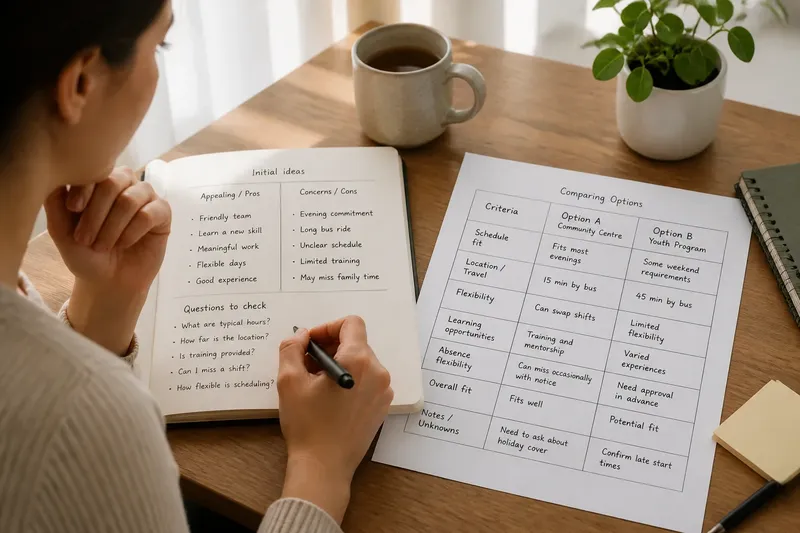
Comparison seems to promise a simple reward: look long enough and you will find an option with no meaningful downside. But everyday choices involve trade-offs. A quieter café may be farther away; a lighter jacket may offer less warmth. More browsing can reveal another possibility without settling which trade-off matters most to you.
The search can also change its purpose. At first, you may be checking whether a lamp fits your nightstand. Later, you may be reading reviews to make sure you will not regret buying it. Those are different tasks: one checks a concrete requirement, while the other asks for certainty about a future feeling.
For a choice that is easy to revise and unlikely to cause serious harm, preventing every possible regret is an unrealistic standard. The aim is not to prove you chose the best option available. It is to choose one that serves your priorities well enough.
How do you decide what “good enough” means?
Good enough does not mean careless or random. It means an option meets the conditions that matter most, while its drawbacks remain acceptable. Name those conditions before more browsing gives every minor feature equal weight.
Suppose you need a bedside lamp. You might want warm light, a base that fits the nightstand, and a switch you can reach from bed. A sculptural shape or a feature you would rarely use may be pleasant, but it need not decide the purchase.
Separate requirements from preferences. A requirement rules an option out if it is missing. A preference helps you choose between options that already qualify. Keep requirements focused on actual needs, rather than turning every appealing detail into a condition.
- Check the fit: If the base fits the available space and leaves the path clear, keep the lamp in consideration; if it does not, rule it out and look for a smaller design.
- Check the light: If the lamp provides the kind of light you need for reading, keep comparing preferences; if it does not, choose an option intended for that use.
- Check the switch: If you can reach and operate it comfortably from bed, accept the control; if not, look for a reachable switch or another control method.
- Check the cord route: If the cord can run without crossing a walkway, keep the lamp on the shortlist; if it would obstruct the path, choose a safer placement or a different lamp.
- Check the dimmer: If adjustable brightness matters to you and the lamp has it, treat that as a preference met; if it is absent, decide whether the fixed light remains acceptable rather than making the feature a new requirement by default.
- Check the appearance: If you like the color or finish, use it to break a tie; if you do not, consider whether the practical requirements still outweigh that preference or choose another qualifying option.
- Check compatibility and directions: If the product label and manufacturer’s instructions support the intended use, proceed on that basis; if they do not, pause and ask the manufacturer or a qualified professional where safety matters.
The point is to connect each observation to a decision. If a lamp fits and works for your needs but has a plain finish, that drawback may be acceptable. If it blocks the walkway, the practical mismatch matters more than its appearance.
How can a stopping rule keep the search useful?
A stopping rule says what must be true before you stop searching and choose. It shifts the question from “Have I seen every option?” to “Do I have the information I need to decide?” The first question has no natural end; the second can have a clear answer.
- Name the job. Write one sentence describing what the choice needs to do. For a lamp, that might be, “Give me comfortable light for reading in bed.”
- Set the requirements. Identify the conditions that would make an option unsuitable, and separate them from preferences.
- List missing facts. Note what you still need to check, such as fit, a feature, or the return policy.
- Set a search boundary. Decide to compare the options already on your shortlist or consult one more relevant source for a specific missing detail.
- Choose when the conditions are met. Pick the first suitable option, or use your strongest preference to choose between suitable options.
Imagine you need a notebook for meeting notes, and the following details are invented for this example. You start with two options: Notebook A fits your bag and works with your pen, but has a plain cover; Notebook B also fits and works with your pen, and has a sturdy cover you prefer. You decide that fit and pen compatibility are requirements, while cover quality is a preference. You check those details for both notebooks, then compare their covers. Both meet the requirements, and B better matches your preference, so you choose B. The observable result is a notebook ready for your next meeting; the trade-off is that you have not compared every notebook on sale.
Match the boundary to the decision. Choosing tonight’s meal needs less investigation than making a substantial commitment or a choice that affects health or safety. For consequential decisions, gather relevant information and consult a qualified professional where appropriate; a shortcut designed for a reversible choice does not belong there.
When should you keep comparing, and when should you stop?
Keep comparing when a missing fact could change your decision. If you do not know whether a lamp fits the nightstand, check its dimensions against the available space. If both shortlisted lamps fit, another round of style reviews may add little.
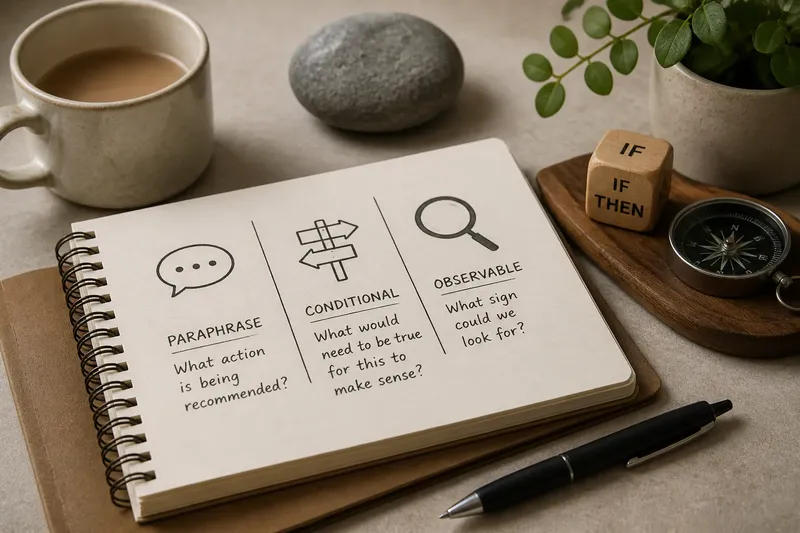
Before opening another tab, ask: What fact am I looking for, and what would I do differently if I learned it? If you can name a missing fact and the action it could change, look for it. If you cannot, you may be seeking reassurance rather than decision-relevant information.
Say you have shortlisted two cafés for meeting a friend. For this invented situation, assume both are easy to reach and have food your friend can eat. You keep checking reviews, but no likely review detail would change the plan. You choose one and send the invitation. The expected observable result is a decided meeting place, not proof that it is the best café available.
Sometimes a fresh detail reveals an assumption you did not know you were relying on. Perhaps you assumed a notebook had lined pages, or thought a café served food at the time you planned to go. Check a concrete uncertainty when it matters, then return to your original requirements.
What questions help you decide without chasing certainty?
How many options should I compare?
There is no universal number that makes a choice sound. Compare enough options to see that your main requirements can be met, then stop when another option is unlikely to change your decision.
What if two options meet all my priorities?
Your requirements have done their job: they ruled out unsuitable choices. Use a preference that matters to you, choose the easier option, or accept either one instead of inventing a new requirement.
How can I tell whether I am seeking information or reassurance?
Information answers a question that could affect your choice, such as whether an item fits a shelf. Reassurance asks for a feeling that the choice cannot disappoint you, and another comparison may not provide it.
Does a stopping rule mean I should ignore my doubts?
No. A specific doubt can reveal a missed requirement or relevant risk, so name it and check what evidence would address it. A general wish to eliminate every possibility of regret is not a useful requirement for a low-stakes decision.
What should you do after you choose?
Give the decision a fair chance to do its job. Use the notebook for meeting notes before judging its cover, or go to the café you agreed on and enjoy the time with your friend. Assess the choice against its purpose rather than against every alternative you did not select.
If a clear problem appears, respond to that problem. A lamp that does not fit may need to be returned; a notebook that does not work with your pen may need replacing. A concrete mismatch is different from reopening a choice because another option might, in theory, have been better.
Keep one specific lesson for next time: perhaps page format matters more than cover color, or a café’s location matters more than its décor. For the next low-stakes decision, use the perfect choice myth as a cue to name your requirements, check any consequential unknown, and stop once another fact is unlikely to change what you do.