A Ten-Minute Review for a Plan That Has Drifted
A ten-minute review for a plan that has drifted helps you keep its useful purpose, account for current constraints, and choose a manageable next action.
A ten-minute review for a plan that has drifted should help you decide what to keep, change, or release—not pressure you to revive the original schedule. Maybe the language lessons you meant to do after dinner keep sliding past, or a home project no longer fits the weekends you have. Start by separating the aim from the plan you once built around it.
What kind of drift are you dealing with?
Choose the situation that best describes the plan today. The point is not to diagnose yourself; it is to pick a review that matches the problem.
- The aim still matters, but circumstances changed. Fit the plan to the time, energy, or resources you actually have now. Keeping the old schedule may be less useful than preserving the purpose.
- The plan is possible, but you keep putting it off. Look for a small point of friction, such as an unclear first action or a tool you have to find. A more specific next move may be enough to restore momentum.
- The original aim no longer feels worth pursuing. Give yourself permission to pause or stop. A plan does not deserve effort just because you once made it.
- You cannot tell which situation fits. Review the original aim and current constraints before deciding. A short pause can reveal whether the obstacle is practical or whether your priorities have changed.
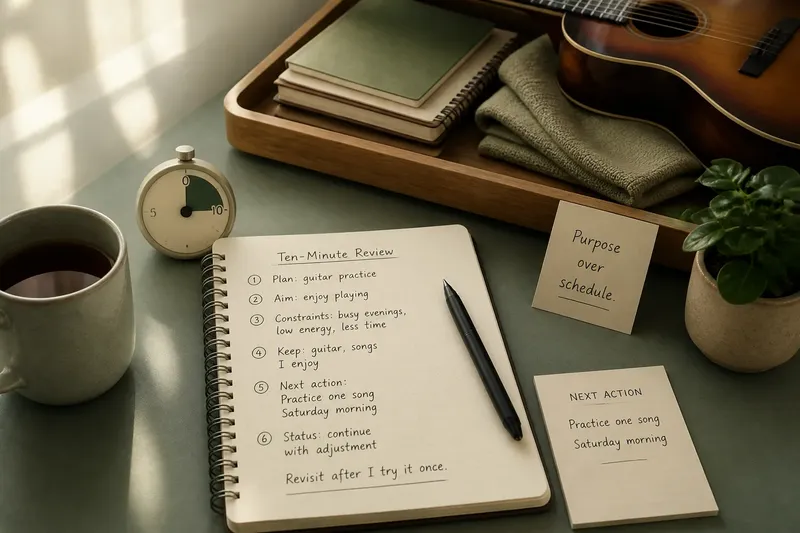
Say you planned to practice guitar for half an hour after work, but evenings now feel crowded. Imagine that, during this review, you realize the aim is still to enjoy playing, not to follow a particular schedule. You might keep the guitar lesson and choose one song to practice during a quieter part of the week; the observable result would be a clear, shorter session on your calendar rather than another vague promise.
How does a ten-minute review for a plan that has drifted work?
Use a timer if it helps you stay focused, and write brief answers in a notebook or notes app. Give each prompt a minute or two. You are making a current decision, not defending an old one.
- Name the plan. Write one plain sentence about what you intended to do. Keep it concrete enough that you can recognize it.
- Recover the original aim. Ask what you hoped the plan would make possible. Describe the purpose without copying its old deadline, routine, or format.
- List current constraints. Note what has changed in your available time, energy, responsibilities, access, or interest. Separate what is true now from what you assume might happen.
- Keep one useful element. Choose a piece that still serves the aim: a location, a tool, a recurring cue, a person to contact, or a particular part of the activity.
- Name one manageable next action. Make it small and visible. “Open the course and choose a lesson” is clearer than “get back on track.”
- Choose a status. Continue with an adjustment, pause with a date or condition for reconsidering, or stop. Write down your choice so the plan is not left in a permanent maybe.
At the end, check that the next action fits the constraints you listed. If it does not, shrink or change it rather than adding a fresh demand.
What should you keep, change, or stop?
What if the goal still matters but the schedule does not?
Keep the purpose and change the routine. Pick a time or setting that fits your present week, even if it looks less ambitious than the original plan.
What if the next action feels too large?
Reduce it until you can describe a clear beginning, such as laying out the materials or opening the document. If even that feels wrong, reconsider whether the aim still matters.
What if you no longer want the original outcome?
Pause or stop without treating the earlier effort as a debt. If there is a useful part you still value, keep that part separately rather than carrying the whole plan forward.
What if another person depends on the plan?
Make the change visible to them and agree on what happens next. A private decision to pause may leave someone else expecting work or support you no longer intend to provide.
How do you make the next action manageable?
A next action should be specific enough to start without another round of planning. “Work on my portfolio” leaves several decisions open. “Choose one project image and add a caption” gives you a defined task and a visible stopping point.
Match the action to the kind of friction you found. If time is tight, choose a shorter session. If getting started is the obstacle, prepare the materials in advance. If you are unsure about the aim, make the next action a conversation or a short reflection rather than more work.
Leave room to change course. You are not promising to complete the whole plan; you are choosing a reasonable way to learn whether this version still fits. If the action repeatedly feels mismatched, treat that as a reason to review the aim or constraints again, not as evidence that you should simply push harder.
When should you revisit the plan?
Pick a natural point for checking in: after one session, at the end of a current commitment, or when a known constraint changes. Avoid setting a review date so soon that you only judge whether you followed the plan, or so vaguely that the decision never returns to view.
Write one sentence beside your next action: “I will reconsider this after I try it once,” or “I will revisit this when my schedule changes.” That note keeps a pause intentional without turning it into an open-ended obligation.
A ten-minute review for a plan that has drifted is useful when it leaves you with a choice you can name: continue differently, pause deliberately, or stop. Keep the part that still serves your aim, and let the next action be modest enough to fit the life you have now.